
Trace Athens-Clarke Former Owners by Transfer
Build a backward transfer table first. One row per deed keeps a repeated surname or a neighboring lot from pulling the Clarke County chain off course.
| Transfer date | Grantor to grantee | Deed type | Book/page |
|---|---|---|---|
| Newest | Prior owner to current grantee | As indexed | Current deed |
| Previous | Earlier owner to that grantor | As indexed | Acquisition deed |
| Repeat | Each earlier grantor to grantee | Warranty, quitclaim, estate, or other | Keep each citation |
Treat the current map code and legal description as fixed controls. Street addresses grow less dependable as Clarke County numbering and subdivision descriptions change over the decades.
Kofile Opens the Athens-Clarke Deed Index to 1801
Deed research in Clarke County reaches back to 1801. The Clarke Kofile index covers the General Index to Deed Books through 1984. That starting year is no accident. It matches the county's founding, which gives former-owner research unusual depth in the deed records.
Search controls let you filter the index by record type, year, party, last name, and first name. There is also a direct route by book, volume, and page. That shortcut helps if you already know where a deed sits. The index is the entry point for that documented historic range of Clarke County property records.
Keep expectations realistic, though. Index coverage does not mean every deed image is online. Images may appear distorted until purchased, and printing at the courthouse follows local equipment rules.
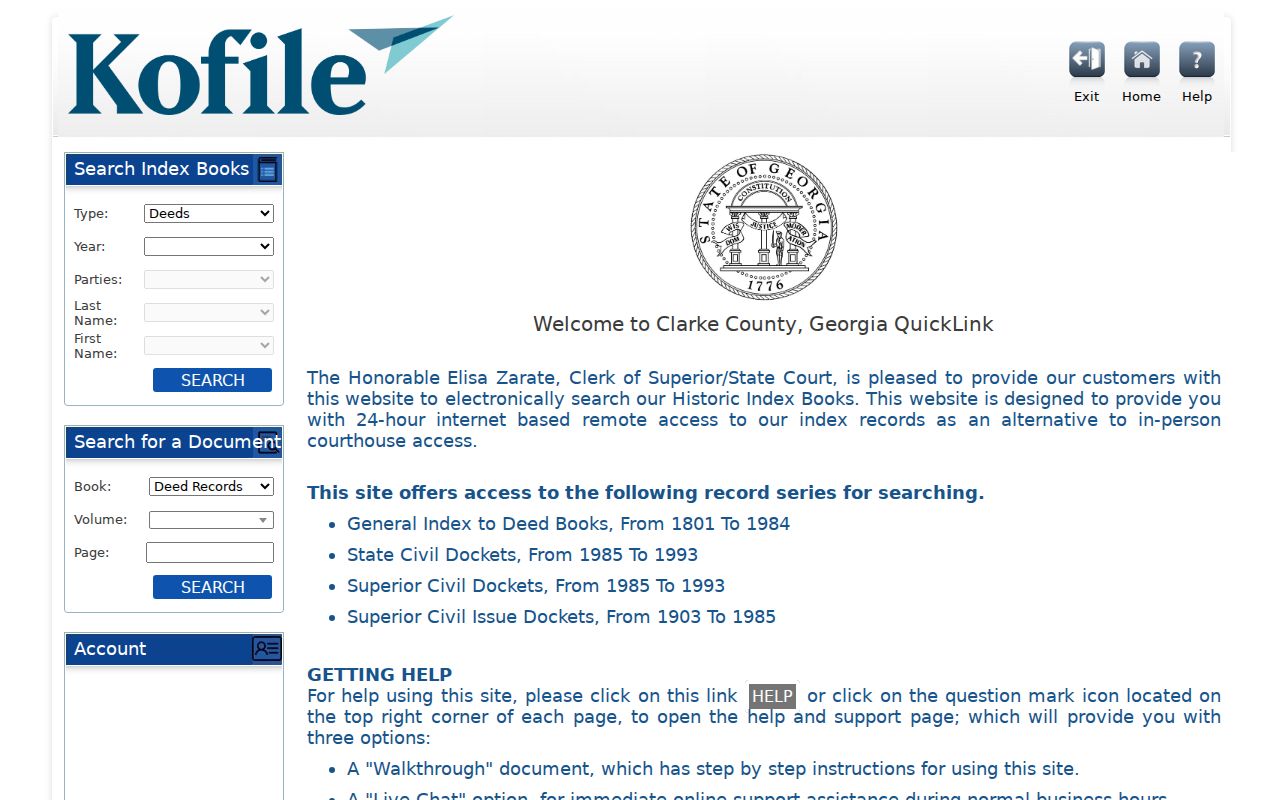
Log every detail for each link in the chain. Record the index type, year, party role, names, book, page, and image status so the Clarke County deed chain stays auditable.
Bridge Athens-Clarke Former Owners Across Coverage Gaps
Do not assume 1985 through 1998 is covered by Kofile's historic label. The gap needs its own source. The GSCCCA real-estate index searches names, subdivision, unit, block, lot, county book and page, date range, party type, and instrument type. Confirm absent years or images with the Clerk. That office is the official custodian. Visit 325 East Washington Street, Suite 450, Athens, weekdays from 8:30 a.m. to 5 p.m.; county guidance cites a $0.50 reference for a deed or plat copy.
Reconstruct the Clarke County Deed Chain Backward
Work in reverse from the most recent confirmed grantee. The identity of the Clarke County land matters as much as each person's identity, so keep the parcel description anchored to every step.
- Find the current grantee's acquisition deed for the exact parcel.
- Read the grantor and any prior-deed citation.
- Search that grantor as an earlier grantee, using initials and name variants.
- Repeat and flag every unresolved gap.
- Grantor and grantee
- The parties conveying and receiving an interest.
- Chain of title
- The ordered sequence of ownership instruments.
- Reverse index
- A party-role index used to work backward.
- Quitclaim versus warranty
- Different deed forms whose effect must be read from the document.
Reconnect Athens-Clarke Estate Transfers
A death can interrupt the neat deed sequence, and probate files fill the break. Clarke probate petitions, wills, estate papers, administrator bonds, inventories, and year's-support files may identify heirs or representatives. Orders to sell land can do the same. Search executor, administrator, and devisee name variants too. Then tie the event to a deed, since probate explains why a transfer happened. An heir named in a filing is not automatically a proven former owner. Confirming the parcel takes a deed.
Use Clarke Tax Digests as Historical Year Markers
The Clarke tax-digest books cover 1800 through 1899 and 1900 through 1935. Older volumes are alphabetical within militia districts. A modern street search will fail. Ask which district covered the land, then search surname and year. A digest is a year marker, not a deed. It places a name with taxable land, and county gap lists also flag books stamped for microfilm with no copy plus volumes never filmed, which points researchers to the physical records instead.
Separate Former Athens Occupants From Prior Owners
The Heritage Room is rich with Athens history. Its collections include directories, maps, microfilm, newspapers, photos, and architectural records. Selected Athens directories from 1889 through 1958 can show residents, spouses, occupations, addresses, and street guides. That can bridge a former address or householder in a historic district. Occupancy is not title. So confirm previous Clarke County owners through deeds, plats, probate, or tax evidence.
Match Athens-Clarke Former Owners to the Same Land
A name chain fails on the wrong parcel. Compare each deed's lot, block, subdivision, acreage, bearings, adjoining owners, and prior-book references. ACC plats carry map codes such as 173A3 H011, 163D3 N001, and 251 028B. Preserve the exact format. The code bridges assessor, tax, GIS, and request records.
Final plats earn their keep where a tract was split, combined, or given a new address. ACC Planning assigns addresses for final plats, new buildings, and certain alterations. Final plats are recorded through the Clerk. That process explains why an earlier owner appears under an old street number or a larger parent tract. A plat alone does not prove title.
PT-61 transfer-tax records offer another check. They can supply sale price, buyer and seller addresses, and deed or plat cross-references. Use them to test a transfer row. They are not a substitute for the deed itself. When legal descriptions stop matching, mark the chain unresolved and search the parent tract, corrective deeds, estate files, or subdivision records before going on.
Know How Far Athens-Clarke Ownership Records Reach
The online index reaches back to 1801. Even so, older images, fragile books, and gaps may still send you to the courthouse. They may also send you to the Georgia Archives or the Heritage Room. Digitization is an initiative, not proof of full coverage. For pre-1900 Clarke County material, the Georgia Archives guide points to the Virtual Vault and the FamilySearch Catalog. FamilySearch requires free registration. Some images carry access limits. The county cards describe dates and gaps. The county-record collection holds tax digests, deed books, and probate materials. Treat these as fallback channels after the local index and the Clerk.
Keep a negative-search log. Record surnames, initials, roles, years, books, and archives checked. When a volume is missing or was never microfilmed, note that gap plainly. Never fill a former-owner timeline from a directory or an unsourced family story.
What if two sources disagree? Prefer the land description and the chronological deed sequence over a directory name. Cite the conflict, then stop the chain at the last proven transfer.
Record limit. Use former-owner records for house history, estates, and property diligence. Never use them to track, harass, or harm a living person.