
Compare Athens-Clarke Property Value Types
Athens-Clarke records hold several numbers, and each one answers a different question. Before comparing any property value, attach its year and its source so the figures stay honest.
| Value | What It Is | Where |
|---|---|---|
| Fair market value | The assessor's full-value estimate for the digest | Assessor record and tax bill |
| Assessed value | Forty percent of fair market value before applicable adjustments | Assessor and tax record |
| Net taxable assessment | Assessment after exemptions that apply | Tax bill |
| Last sale price | Consideration tied to a past transfer | Deed and PT-61 context |
Georgia law assesses property at 40 percent of fair market value for tax purposes. That ratio is a tax rule, not a prediction of what a parcel will fetch on the open market.
Read the 2026 Athens-Clarke Value Fields
The 2026 bill insert lays out fair market value, net assessment, exemption codes, the map code, and the physical location. It also lists the taxpayer as recorded on the deed, the millage rate, and the total due. Those labels matter. They keep the value of the parcel separate. The tax math sits stacked on top of it. The Property Tax Division explains taxable situs and the 40 percent assessment rule. Use the bill year when comparing figures, since notices shift with each cycle.
Find the Athens-Clarke Assessed Value at Its Source
The Tax Assessor appraises property at fair market value and prepares the digest by August 1. Official guidance points to qPublic for searches by owner, address, parcel number, and legal description. Clarke County offers no substitute starting point. Start a property value inquiry on the assessor page.
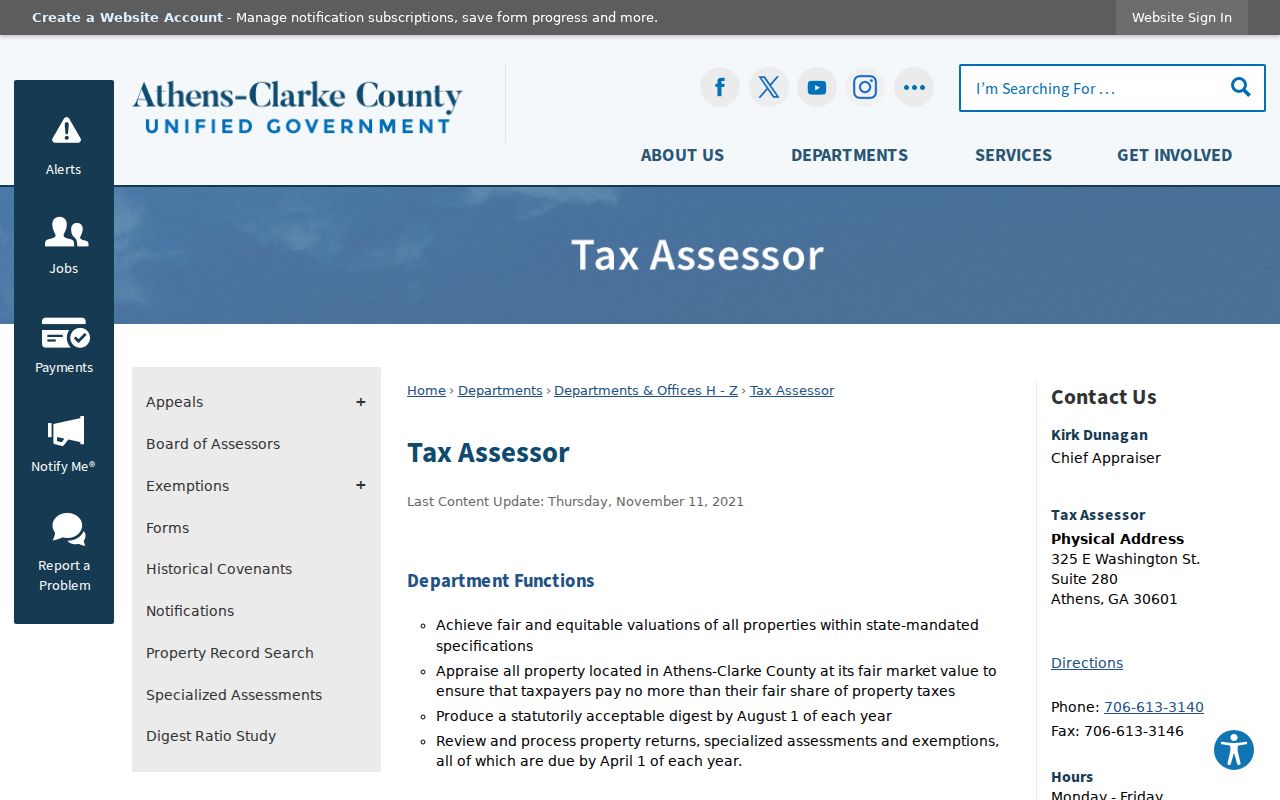
You can also call 706-613-3140 or visit Suite 280 at 325 East Washington Street. Weekday hours are 8 a.m. to 5 p.m.
Estimate an Athens-Clarke Property Value From Records
Anchor every dated number to its map code. That keeps a property value attached to the correct parcel. An assessed figure from one year and a transfer from another should never sit side by side without labels.
- Search qPublic by address and copy the map code.
- Record fair market value, assessed value, exemptions, and tax year.
- Check the latest deed and PT-61 context for a dated sale price.
- Compare only like measures and state why each may differ.
- Assessed value
- The statutory portion of fair market value used in taxation.
- Market value
- The assessor's mass-appraisal estimate for the digest.
- Assessment ratio
- The 40 percent relationship used in Georgia.
- Consideration
- A sale amount associated with a transfer, not a current appraisal.
Compare Athens-Clarke Sale Price With Assessor Value
A recorded sale price belongs to a single transaction on a particular date. The Georgia PT-61 index adds transfer-tax context, including sale price, buyer and seller addresses, and deed or plat references. A deed also names the parties.
Not every price reflects the market. A non-arm's-length transfer, family conveyance, quitclaim, or estate event can distort a comparison. Check the instrument type first.
Separate Athens-Clarke Exemptions From Property Value
Homestead and other exemptions shrink the net taxable assessment without touching the underlying fair market value field. The current exemptions page covers eligibility and timing. Watch ownership changes. A trust or an added spouse can trigger reapplication. For the tax bill, exemption application, and appeal workflow, turn to the dedicated property tax records guide.
Use Athens-Clarke GIS as Value Context, Not an Appraisal
GIS layers explain a lot. Parcel size, zoning, buildings, roads, waterways, and municipal boundaries can show why two nearby records differ. The ACC GIS service supplies those layers. It is not a survey, and it never produces a defensible market price. Compare dated official values and recorded transfers rather than unsupported online estimates. For a defensible opinion of market value, get a qualified appraisal.
Date Every Athens-Clarke Property Value Comparison
The Assessor produces an annual digest. Every value record therefore belongs to a tax year. A deed and its PT-61 belong to a transfer date. A tax bill belongs to its own billing cycle. These dates rarely align. Unlabeled comparison builds a false trend, so record the source, map code, and field name beside every figure.
The 2026 bill notice reports bills mailed August 20 and due October 20. Those dates mark one cycle only. They set no permanent schedule, so check current notices again in later years. The online tax portal also sits behind a verification step. The Tax Commissioner's office and the printed bill remain dependable channels.
Recent ACC material also discusses HB581 and floating homestead-exemption context. Grant amounts can change. Never hard-code one into a property value estimate. Exemptions move the taxable assessment, while the fair market field reflects the assessor's valuation. Keep those columns separate, and year-to-year comparison becomes useful.
Know What an Athens-Clarke Assessed Value Cannot Prove
An assessed value is a tax-system number, derived from fair market value and Georgia's 40 percent ratio. It promises nothing. It is not what a buyer will pay, not a boundary determination, and not a title conclusion. Annual timing can also leave it behind a newer sale.
Keep land value, improvement value, fair market value, assessed value, exemptions, and net taxable assessment in separate rows. A change in one may have a different cause. Construction moves improvements. A plat can alter acreage. An exemption shifts the taxable amount. None of them alone supplies a current sale price.
Track the same map code and value field across years. Note any deed or addressing change. Take the field from the Assessor rather than guessing from a generic layout, and the Athens-Clarke value comparison stays reproducible.
A transparent value worksheet names the parcel, source year, valuation field, exemption effect, and transfer date. Readers then compare like with like. No dollar amount gets mistaken for another measure.
Value versus price. An Athens-Clarke assessed value is not the property's sale price and is not an appraisal of what it would sell for today.