
Identify Who Owns an Athens-Clarke County Property
Start with a street address. Work toward the recorded instrument. The Athens-Clarke County qPublic search is the natural first stop for an owner of record. Per official county guidance, it supports owner, address, parcel number, and legal-information searches. Take the parcel number it returns. Pair that number with the deed index at the Clerk's office. The chain of ownership starts to take shape.
- Enter the location address and select the matching parcel, checking street direction, unit, and suffix.
- Copy the parcel or map code exactly and note the taxpayer or owner display and record date.
- Use the name and map code to locate the newest deed through the Clerk's Kofile or GSCCCA route.
- Confirm that the deed's grantee and legal description refer to the same parcel before naming an owner.
This method reveals land ownership, not occupancy. A building's residents may have no title at all. When the address search comes up empty, call the Tax Assessor at 706-613-3140, or search using a map code from a tax bill, plat, or permit instead.
The Athens-Clarke Map Code Connects Each Owner Source
Athens-Clarke County assigns every parcel a map code. It serves as a durable assessor identifier. Official examples follow formats like 173A3 H011 and 251 028B. A street number can change after a final plat, new construction, or an addressing action. But the map code holds steady. That makes it the best cross-check across the assessor roll, the tax bill, a deed reference, the GIS map, and any focused records request you send.
A few terms anchor any ownership search. An owner of record is the name an official roll or ownership instrument carries. A grantee receives an interest under a deed. The situs is the physical location of the parcel, while a mailing address is simply where notices go. Neither address alone proves title.
Copy map codes exactly as written, with every space, letter, and punctuation mark intact. One mistyped character can pull up a nearby parcel and point you to the wrong property owner entirely.
Note: The 2026 tax bill labels its taxpayer as recorded on the deed, but the deed remains the stronger ownership confirmation.
Where Athens-Clarke County Property Ownership Appears
No single source answers every ownership question. Read the assessor digest, the tax roll, and the recording system together, and note the date you checked each one, since they do not always update on the same schedule.
| Ownership source | What it contributes | Access route |
|---|---|---|
| Assessor roll | Taxpayer or owner display, mailing location, map code, value context | qPublic, office, or phone |
| Latest deed | Grantee, recording reference, legal description, transfer date | Kofile, GSCCCA, or Clerk counter |
| Tax bill | Taxpayer as recorded on deed, physical location, map code, bill year | Tax portal or Tax Commissioner |
| GIS | Parcel relationships, address points, zoning and municipal-boundary clues | Official GIS Viewer |
Think of these sources as a verification ladder. A tax account or GIS map is a strong clue, but only the latest recorded deed confirms who holds title now.
Read the Athens-Clarke Assessor Owner Display Carefully
The Athens-Clarke County Tax Assessor appraises property and prepares the annual digest. It also processes returns and exemptions. The office sits at 325 East Washington Street, Suite 280, Athens. Hours are generally weekdays, 8 a.m. to 5 p.m. When the qPublic form is inaccessible, staff can verify an ownership display by phone. The official Assessor page serves as the county's route for parcel ownership and digest questions. It also offers parcel tools.
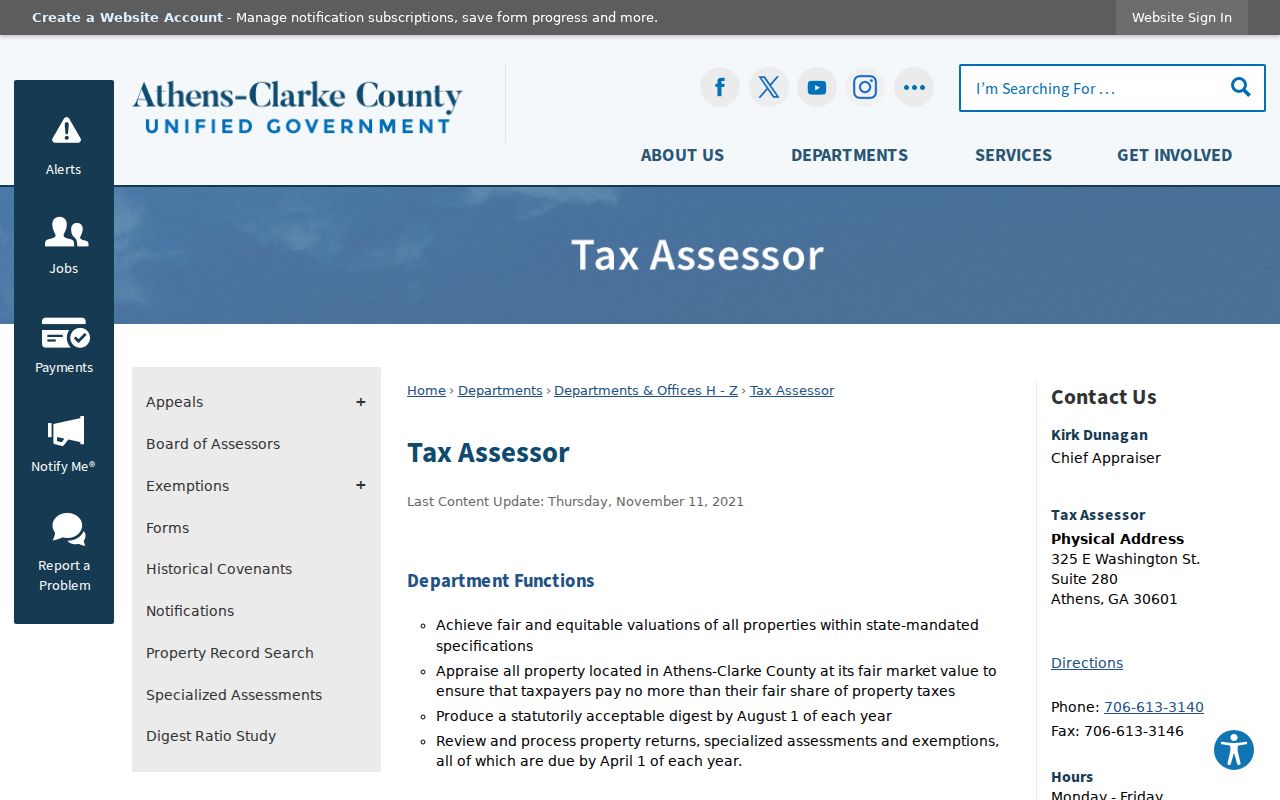
The Assessor page pairs online parcel tools with a phone and counter route. That office fallback matters when the web form is blocked or a recent transfer has not yet reached the roll.
Trace an Athens-Clarke Assessor Name to the Latest Deed
The Clarke Kofile index lets you search by instrument type, year, parties, or first and last name. It also offers a book, volume, and page route. Its historic index clearly covers 1801–1984. For a more recent deed, turn to the GSCCCA real-estate index. You can also ask the Clerk of Superior and State Courts directly. Match the newest recording against the parcel. Compare the recording date, grantee name, deed type, book and page, and legal description. Shared names are common, so chronology and the property description carry the weight. For a deeper present-record check, see the current-owner guide. For a full ownership history, use the former-owner trail.
Ownership limit. A roll name or index line is not a title examination. A qualified professional must resolve competing interests, unrecorded claims, or legal title.
Decode Athens-Clarke Trust, Estate, and Company Owners
The owner of record may be an LLC, trust, estate, executor, administrator, or representative. It may not be a person at all. Search the deed index using role and name variants to catch these entries. The Georgia eCorp Business Search handles business-name lookups. It offers starts-with, contains, and exact-match modes, plus searches by control number, registered-agent name, and officer name. An entity filing explains the business, not the title. When an owner has died, Clarke Probate Court material may show a petition, heirs, an administrator, an inventory, a year's support, or an order to sell land. The answer becomes reliable only when that probate event connects to a deed. The transfer must touch the parcel itself.
Note: A trust or company mailing address may belong to an agent and should not be treated as the property's occupied address.
Use Athens-Clarke Owner Records Beyond the Web
The web is just one channel. The Clerk at 325 East Washington Street, Suite 450, Athens, provides the official deed and plat route. Weekday hours generally run from 8:30 a.m. to 5 p.m. County guidance lists a $0.50 reference for deed or plat copies. Kofile images may appear distorted until purchased. GSCCCA, by contrast, gives free summary access without images and paid options for full copies. When planning material is missing, send a narrow request under the Georgia Open Records Act. State the address, map code, category, date range, and format you need. Production may take longer than three business days. In that case, guidance calls for an estimated timeline, likely cost, and any applicable exemption. Older ownership questions can also lead to physical deed books. County microfilm, tax digests, or the Heritage Room may hold the rest.
Use the Athens-Clarke Tax Bill as an Owner Cross-Check
The 2026 tax bill earns its place as a cross-check because one dated sheet carries the taxpayer name, the physical location, and the map code. It also lists fair market value, net assessment, exemptions, the due date, millage, prior payments, penalties, and back taxes. Only the first three items identify the parcel and its record name. The rest describe the tax account itself. Keep those roles separate.
When an account resists online lookup, call the Tax Commissioner at 706-613-3120 or visit Suite 250 at 325 East Washington Street. The Tax Commissioner bills and collects; the Assessor appraises and maintains the digest. Neither office replaces the Clerk as custodian of deed records.
A dated bill can reveal a mismatch worth chasing. A taxpayer who differs from the latest grantee? Compare the bill year with the recording date and ask whether the digest has caught up. A location that differs from a current address? Check the map code against the final-plat addressing record. Describe what conflicts instead of assuming which source is wrong.
Set Lawful Limits on an Athens-Clarke Owner Lookup
Put a date on every answer to who owns a property in Athens-Clarke. Add a source label to it. State any gap plainly. Georgia's Safe at Home program launched July 1, 2026. It and VoteSafe can shield qualifying residence addresses. An omitted or substitute address may be intentional.
Ownership data supports purchase due diligence, boundary questions, estate research, deed-fraud prevention, and civic review. It does not establish who lives at a site. Never expose a protected address. Never use public records to harass, intimidate, stalk, or harm anyone.
Keep an evidence note. Record the situs, the exact map code, the assessor display and year, and the newest deed grantee with its recording reference. Add each check date. When an entity, trust, or estate appears, label that role. Do not claim a private person owns the land. Say so when only an index line was available. Note that the deed image itself was not reviewed. Georgia's free FANS service sends name and address match notices for later recordings. Those notices aid deed-fraud awareness. They build no historical chain. They never decide whether a filing is valid.
A narrow ownership question also prevents role confusion. A taxpayer, permit applicant, registered agent, executor, and occupant can all be different people. Name only the role the record proves. Reconnect that role to the parcel through map code, legal description, and date.
Best answer format. Name the source, map code, deed reference, and check date, then describe any portal block or unresolved mismatch.